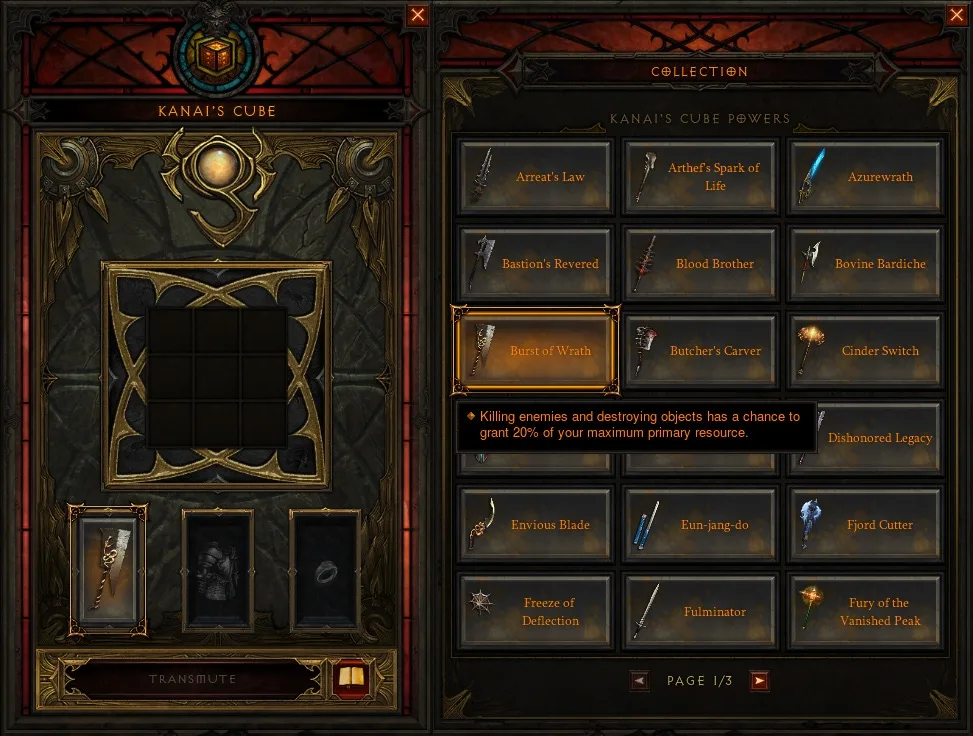
Once your build is assembled, the real endgame begins: optimizing every single item, affix by affix. Reforging and Augmenting via Kanai's Cube are the two tools that turn ordinary legendaries into perfect Ancient gear with maxed-out main-stat values. This guide covers both systems from the ground up, with exact costs, the math behind them, and the optimal order of operations for patch 2.7.x.
Do this cleanly and you'll squeeze several extra Greater Rift levels out of identical gear compared to someone who rerolls at random. It isn't about luck alone — it's about discipline: the right item first, the right affix target, and the main-stat boost only at the very end.
Kanai's Cube — the foundation
Everything here runs through Kanai's Cube, which you find in the Ruins of Sescheron inside the Elder Sanctum. Once found, it sits permanently in every town next to your stash. Through the Transmute action, the Cube converts items, materials and gems.
Two recipes are central to gear optimization:
- Reforge Legendary — completely rerolls an item.
- Augment Ancient Item — adds main stat to an Ancient/Primal item.
What materials you need
Both recipes eat resources, so stockpile early:
- Forgotten Souls — from salvaging legendaries at the Blacksmith.
- Bounty materials from all five acts — from Adventure Mode bounties and Horadric Caches.
- Death's Breaths — from elite enemies on higher difficulties.
- Flawless Royal gems — by combining lower-tier gems.
- High-rank Legendary Gems — leveled at Urshi in Greater Rifts.
Quality Tiers: Normal, Ancient, Primal
Every legendary and set item drops in three quality tiers. They share the same affixes but have different maximum values:
- Normal (Legendary/Set): Standard value range, orange or green border.
- Ancient: Roughly
+30 %higher maximum values on core stats, with a brighter border. Only drops at character level 70. - Primal Ancient: Red border. Every affix rolls at its absolute maximum value — no rerolling required.
0.25 % chance per level-70 legendary or set item.A Primal item is always perfect, but you can't choose which item drops. That's exactly where reforging comes in: you take an item you want and roll for a higher quality.
Why Ancient isn't automatically better
Ancient items have higher maximum values, but they don't guarantee good rolls. An Ancient can roll its affixes at the low end of the expanded range and end up worse than a well-rolled normal piece. Only the right affixes plus the higher quality make a true end-game item.
Reforging a Legendary
The Reforge Legendary recipe completely rerolls all affixes on a legendary or set item — including a fresh chance at Ancient or Primal quality.

Cost per reforge:
50Forgotten Souls5bounty materials from every act (so5of each from Act I through V —25total)
50 Forgotten Souls and 25 bounty mats. Hoard Forgotten Souls over several days so you can "spam" a single item in one sitting instead of running dry after three tries.How to reforge correctly
- Pick a build-defining legendary you want in perfect form — e.g. your weapon or most important set piece.
- Reforge it repeatedly until it rolls Ancient — or ideally Primal.
- On every roll, check the affixes: main stat, critical hit chance, critical hit damage, cooldown reduction, area damage, resource cost reduction, etc.
- Only keep a roll once both quality and affixes line up. An Ancient with bad values is not progress.
Rule of thumb: reforge first to chase Ancient/Primal. Only once the piece is Ancient and has good stats is it worth augmenting.
Reforge vs. enchanting
Don't confuse reforging with the Mystic (Myriam): there you change only a single affix on an item without touching its quality or other stats. Reforging throws everything back into the pot. In practice:
- Enchanting: Item is nearly perfect, just one affix is off → swap it precisely.
- Cube reforge: You want a higher quality tier or several affixes at once → reroll the whole item.
Augmenting Ancient Items
Augmenting adds extra main stat to an Ancient or Primal item by sacrificing a leveled Legendary Gem. It uses the Augment Ancient Item recipe.
Cost per augment:
3Flawless Royal gems of the desired main stat1Legendary Gem — at least rank 30 (weapons), 40 (jewelry) or 50 (armor); it is consumed and destroyed
The Royal gem determines which stat is added:
- Emerald → Dexterity (Demon Hunter, Monk)
- Topaz → Intelligence (Witch Doctor, Wizard, Necromancer)
- Ruby → Strength (Barbarian, Crusader)
- Amethyst → Vitality
The main-stat math
The size of the bonus is driven entirely by the rank of the sacrificed Legendary Gem:
+5 main stat per gem rank
- Rank 30 (minimum for weapons) →
+150main stat - Rank 40 →
+200 - Rank 50 →
+250 - Rank 100 →
+500 - Rank 150 →
+750
An augmented item shows this bonus as a separate extra line below its other stats. You can re-augment an item multiple times — the old augment value is overwritten, not added. So when you later push a higher-rank gem into it, the new value simply replaces the old one.
Keep your augment gems separate
To level augment gems quickly, run Greater Rift chains and, at the end, deliberately level a "sacrifice gem" at Urshi instead of your build gems.
Strategy & Order of Operations
Augmenting is expensive and you'll keep replacing gear — don't waste it on items you'll later drop.
- Reforge first: Use reforging to hunt Ancient/Primal versions of your build pieces.
- Check the affixes: Confirm the Ancient has better values than your current piece. Only then is it an end-game item.
- Close the gap: Fix one last off affix at the Mystic.
- Augment last: Augment only your final items, using the highest-rank gems you can manage (rank 100+ in the late game).
13 slots = a huge main-stat block
A fully geared character has up to 13 augmentable slots: helm, shoulders, chest, gloves, pants, boots, belt, bracers, amulet, two rings and one or two weapon/off-hand slots. With rank-100 gems that's potentially +6,500 or more main stat — a massive, often underrated boost to both damage and toughness.
Common Mistakes
Other typical mistakes:
- Sacrificing build gems: Never throw your active
Bane of the Trapped(or similar) into the augment recipe. - Wrong main stat: Mixing up Emerald/Topaz/Ruby/Amethyst.
- Augmenting too early: Optimizing items you'll replace within two play sessions.
- Wasting rank-30 gems:
+150is the floor — in the late game it's barely worth it if you can hit rank 100+. - Ignoring Forgotten Souls: Without a stockpile (50 per attempt) you quickly stall on reforging.
Pro Tips
- Mat routine: Run a few bounties each session so you always have
1,000+mats per act on hand. - Season sprint: New Seasons start with no Primal unlock — prioritize an early GR70 solo to enable Primal drops for the rest of the Season.
- Augment waves: Collect all final items first, then level several sacrifice gems to rank 100+, and augment the whole character in one sitting.
- Use Amethyst on purpose: On pure toughness/support slots, an Amethyst augment (Vitality) can beat more damage — especially for support characters in four-player groups.
- Re-augmenting pays off: Once your sacrifice gems climb past rank 130, re-augment your key slots — every extra rank is a flat
+5main stat.
 Login with Battle.net