
Once your Diablo 3 hero hits the level cap of 70, the real endgame begins: Paragon. This practically endless leveling system converts all further experience into Paragon levels that grant freely-assignable stat points. Paragon is the single most important source of passive power in the game and the main reason two players with identical gear can still be ten or more Greater Rift tiers apart. This guide explains every single Paragon stat, all caps and soft caps, the optimal order to spend points, and the most efficient ways to farm Paragon at speed.
What Are Paragon Levels?
After level 70, your earned experience no longer feeds normal levels but instead Paragon levels. Each Paragon level grants one point you freely invest into one of four categories (tabs). The system was introduced in Patch 2.0.1 as "Paragon 2.0," replacing the old, capped Paragon-100 system.
Account-Wide Experience
Paragon experience is stored account-wide — tracked separately for Softcore and Hardcore and, within each, for Season and Non-Season: four separate pools (per region). All heroes of the same mode share one Paragon level. If a character dies or is deleted, the Paragon experience it contributed is not lost — it lives safely at the account level.
20,000 — a limit practically nobody reaches. Top players reach Paragon 2000+ per Season, but 800–1000 is already plenty for comfortable T16 farming and Greater Rifts around level 100. By Paragon 800 every capped stat across the four tabs is full; each further point goes into the Core tab.Re-Assign Points for Free, Any Time
Paragon points can be re-assigned for free at any time, so you can run different distributions for boss fights, high Greater Rifts, or fast Bounty farming. Open your inventory (default: I) and click the Paragon button above your attributes.
Getting Started: Open Paragon and Spend Points
- Reach level 70 on a hero — from then on you accumulate Paragon experience.
- Press I for the inventory and click the blue Paragon button in the top left (above Strength/Dexterity/Intelligence).
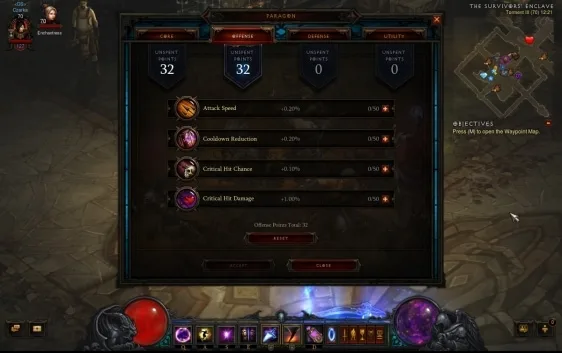
- The Paragon window opens with four tabs: Core, Offense, Defense, Utility.
- Each tab shows your unspent points for that specific category at the top.
- Click the + next to a stat to invest a point, or - to take it back.
- Confirm with Accept, or wipe a tab with Reset.
The Four Categories in Detail
The 16 stats are split across four tabs. The headline stats in Offense, Defense and Utility are hard-capped at 50 points; in the Core tab Movement Speed and Maximum Resource are capped, while only primary attribute and Vitality accept points indefinitely.
Core
- Strength / Dexterity / Intelligence — your class's primary attribute: Barbarian/Crusader = Strength, Demon Hunter/Monk = Dexterity, Witch Doctor/Wizard/Necromancer = Intelligence. Each point gives +5 for pure damage and toughness. Uncapped.
- Vitality — +5 Vitality per point, more Life and survivability. Uncapped.
- Movement Speed — +0.5% per point up to +25%, capped at
50points. - Maximum Resource — e.g. max Arcane Power or Fury depending on class (Demon Hunters gain no Discipline). Capped at
50points.
Offense
- Attack Speed — +0.2% per point, cap
50= +10% IAS. - Cooldown Reduction (CDR) — +0.2% per point, cap
50= +10% CDR (diminishing returns). - Critical Hit Chance — +0.1% per point, cap
50= +5% CHC. - Critical Hit Damage — +1% per point, cap
50= +50% CHD.
Defense
- Life — +0.5% maximum Life per point, cap
50= +25% Life. - Armor — +0.5% Armor per point, cap
50. - Resist All — +5 per point, cap
50= +250 All Resist. - Life Regeneration — fixed regen per point, cap
50.
Utility
- Area Damage — +1% per point, cap
50= +50% Area Damage. - Resource Cost Reduction (RCR) — +0.2% per point, cap
50= +10% RCR (diminishing returns). - Life on Hit — fixed value per point, cap
50. - Gold Pickup Radius — +0.1 yards per point, cap
50= +5 yards (Gold Find until patch 2.6.10).
Understanding Soft Caps and Diminishing Returns
Some stats scale with multiplicative diminishing returns — the last points are worth less than the first. This is crucial for getting the order right.
- Cooldown Reduction (CDR): stacks multiplicatively with gear, a Diamond in the helm, and Paragon. The
+10%from Paragon yields less the more CDR you already have — but for many builds these exact points push you over a key CDR breakpoint (e.g. permanent summon uptime). - Resource Cost Reduction (RCR): also multiplicative-diminishing. Only worth it for resource-hungry builds (e.g. Whirlwind Barbarian, Arcane-hungry Wizards).
- Crit Chance vs. Crit Damage: both are multiplicative with your gear. Keep the CHC to CHD ratio roughly 1:10 so every point is maximally efficient.
Optimal Point Allocation
For most Greater Rift builds, follow this priority list. It assumes you have enough points to max Offense and Utility first.
- Core: Take Movement Speed to
50first (unless gear already covers it), then Vitality as needed to survive, and dump everything else into your primary attribute. Maximum Resource only if you have chronic resource problems. - Offense: Crit Hit Damage
50→ Crit Hit Chance50→ Attack Speed50, with CDR only as much as your build needs to hit a breakpoint. Respect the 1:10 CHC-to-CHD ratio. - Defense: Resist All first (the most efficient defensive stat), then Armor, then Life %. Life Regeneration only in niche builds (e.g. regen tanks).
- Utility: Area Damage is almost always top priority — it massively multiplies your damage in dense packs. Then Life on Hit (healing/survival) or RCR depending on your build, with Gold Pickup Radius last.
Push vs. Farm — Two Setups
- Pushing (high GRs): More Defense (All Resist, Armor, Life %) and Vitality, plus Life on Hit in Utility. Survival beats speed when one death ends the rift.
- Farming (lower GRs, Bounties, T16): Maximum Area Damage, Movement Speed at
50, and full Offense — you want to shred screens and run, not survive.
Seasonal vs. Non-Seasonal Paragon
On top of Softcore and Hardcore, Diablo 3 also separates Season and Non-Season Paragon:
- Seasonal Paragon starts each Season at
0and grows only from Season experience. This keeps the race fair, since everyone starts equal. - Non-Seasonal Paragon is your permanent account Paragon.
When a Season ends, your Seasonal characters roll over to Non-Season, and your Seasonal Paragon experience is added to your Non-Season account (experience is summed, not the higher level taken). This is how your Non-Season Paragon grows Season after Season.
Efficient Paragon Farming
Paragon = experience. Here's how to maximize the XP stream:
- Greater Rifts are the best XP source. Clear them quickly (5–8 minutes) rather than slowly grinding the highest possible tier — XP per minute beats XP per rift.
- Group XP: each additional player near you adds +10% experience from monster kills (+30% in a full group); players far away don't benefit. A coordinated group with a support build also clears much faster than solo.
- Gem of Ease: from rank
25it sets the weapon's level requirement to 1 and grants a flat experience bonus per kill — ideal for pulling alternate characters to 70. For Paragon it does practically nothing. - Pylons: The Conduit Pylon annihilates whole screens — perfect for XP bursts. The Channeling and Power Pylons also speed up clearing.
- Pools of Reflection: each pool grants +25% experience, including bounty and rift completion, until its charge is used up — Greater Rifts have none. In Season, an Altar of Rites seal grants a permanent pool that even survives death (see the Altar of Rites guide).
- Judge gear XP correctly: a ruby in your helm, Leoric's Crown, the Hellfire Ring or Cain's Destiny only apply one tenth of their listed value at level 70 and don't touch the Greater Rift completion bonus — barely noticeable for Paragon. XP potions don't exist, and the Hellfire Amulet grants an extra passive, not experience.
Paragon is a marathon, not a sprint. Consistent, fast group Rift farming beats any desperate solo attempt — and every point stays with you account-wide forever.
 Login with Battle.net