
A turning point for Diablo 3
On August 28, 2015, Season 4 went live across all gameplay regions and marked one of the most significant milestones in Diablo 3's history. The fourth Season was built directly on top of Patch 2.3.0 and bundled several foundational changes that still define the endgame today. At its heart sat a tool that finally brought structure to the often opaque seasonal start: the Season Journey.
Before Season 4, jumping into a fresh Season was a leap into the unknown for many players. Seasons had existed since August 2014 (Season 1 on PC), but they offered little more than a separate leaderboard and a clean economic restart. There was no clear guidance on which goals were worthwhile or in what order to tackle them. With the Season Journey, Blizzard delivered exactly that sense of direction – a framework that took newcomers by the hand while giving veterans ambitious long-term targets. In doing so, it turned the seasonal mode from an optional side activity into the beating heart of the game.
What Seasons were before Season 4
To grasp why Season 4 mattered, it helps to look back. Seasons launched as time-limited races with their own character list: every seasonal hero started at level 1 with no shared gold, materials or gear. When a Season ended, heroes and their loot were folded into the non-seasonal game. The concept was appealing but raw – it lacked any form of guided content.
- Seasons had no objectives of their own, only the regular game content.
- The only extra incentive was season-exclusive legendaries that later rolled into the normal game.
- Progress was abstract: there was no screen showing where you stood or what was worth doing next.
The Season Journey in detail
The Season Journey is a progression interface accessible straight from the main menu that gathers all of a Season's key objectives in one place. It is organized into two structures:
- Chapters walk players step by step through the early hours – from reaching level 70 to unlocking Kanai's Cube and clearing your first Greater Rifts.
- Tiers such as Slayer, Champion and Conqueror challenge experienced players with far more demanding goals, like high Greater Rifts without class set bonuses.
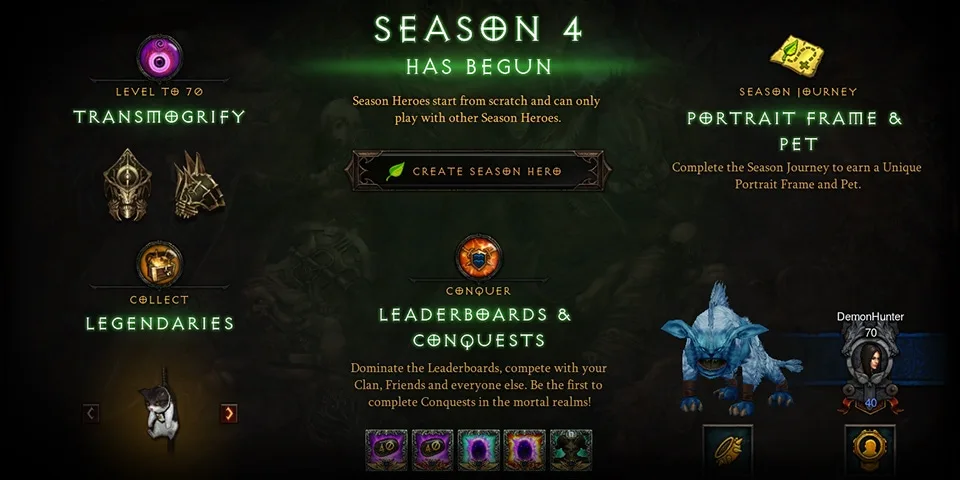
Every completed Chapter and Tier made progress visible and handed out a concrete next objective. The first four Chapters cover the classic ramp-up: hit level 70, raise the difficulty, kill Keywardens and complete bounties, recover Kanai's Cube. From there the Tiers take over with tasks like Greater Rift 20 solo, wearing a full class set and leveling Legendary Gems. The concept proved so successful that it still forms the backbone of every Diablo 3 Season, virtually unchanged to this day.
Why the structure worked
The Season Journey solved a psychological problem: it broke the overwhelming endgame into digestible chunks. Instead of facing a mountain of unclear options, every player always had a manageable list in front of them – a classic pull-through effect that sparks the urge to tick off "just one more task."
The Season Journey turned an open sandbox into a path with waypoints – without taking away the freedom to forge your own route at any time.
Exclusive cosmetic rewards
For the first time, Blizzard tied genuine cosmetic rewards to seasonal progress – an incentive that went well beyond loot alone:
- Completing all Chapters unlocked a unique pet and an exclusive portrait.
- Finishing the Tiers rewarded high-quality portrait frames that showed off your rank.
- Reaching level 70 with a seasonal hero granted head and shoulder pieces of the Conqueror's transmogrification set – collectible piece by piece across multiple Seasons.
A fresh start on Patch 2.3.0
Season 4 inherited the full feature set of Patch 2.3.0, making it one of the most content-rich Seasons of the early era. The patch had gone live weeks earlier, on August 25, 2015, and is still regarded as one of the most influential updates in the game's life:
- Kanai's Cube – the iconic artifact recovered from the ruins of Sescheron that extracts Legendary powers and makes them permanently available.
- Reworked class sets and new bounty rewards that made farming far more rewarding.
- New season-exclusive legendaries and the powerful Legendary Gem Bane of the Stricken.
- Fresh Conquests such as The Thrill, which demanded a Greater Rift 40 clear with no class set bonuses at all.
Kanai's Cube – the centerpiece of 2.3.0
No feature reshaped buildcrafting as radically as Kanai's Cube. The artifact granted three functions at once: extracting a Legendary power (one each for weapon, armor and jewelry), converting materials, and rerolling set pieces. Suddenly players could wield the power of a Legendary without having to equip the item – opening up countless new build combinations and breaking the rigid "best-in-slot" logic.
Smart Loot and Greater Rift tuning
Patch 2.3.0 also refined the loot system: drops were more strongly weighted toward the class being played, and Greater Rift scaling was smoothed out. This made the climb from the leveling phase into the endgame far smoother – progress that the Season Journey now mapped, for the first time, as a tangible sequence of stages.
Community reaction and impact
Reception was almost unanimously positive. Players who had ignored Seasons before came back, because the Season Journey gave them a clear reason to start fresh. The cosmetic rewards spoke to an entirely new player group – collectors who wanted not just the best gear but visible status symbols too. Forums and streams filled with progress reports, and the race to clear the first Tiers became a fixture of every Season launch.
Why Season 4 mattered
The combination of a guided Season Journey, cosmetic rewards and the mighty Kanai's Cube transformed Seasons from a niche experiment into the defining endgame format of Diablo 3. Season 4 laid the foundation for the modern Season model: clear goals, visible progress and collectible rewards.
Practically every later Season built on exactly these pillars. Later patches extended the scaffold carefully – for example through the Haedrig's Gifts introduced with Season 4, which gradually handed out a chosen class's full set across specific Chapters, dramatically accelerating the path into set-based endgame. The later arrival of Set Dungeons (Patch 2.4.0) and the traveler's-step style rewards likewise slotted neatly into the logic Season 4 had established. That is precisely why Season 4 is still regarded as one of the most important turning points in the game's lifespan – the moment Diablo 3 found its definitive seasonal DNA.
 Login with Battle.net