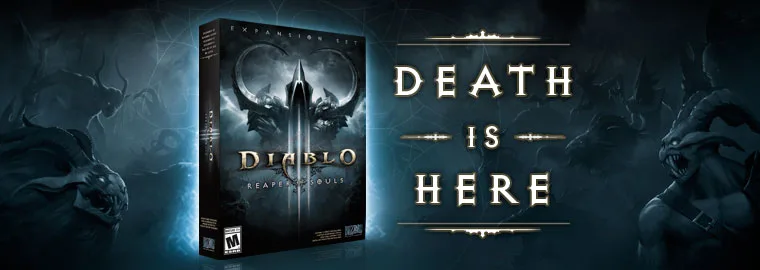
On March 25, 2014, Reaper of Souls released as the first and only expansion to Diablo III. It arrived at a moment when the base game, after its rocky 2012 launch, was still struggling under criticism of its loot, difficulty, and above all the real-money Auction House. The expansion delivered far more than a single new act – it was a fundamental redesign, and many players still point to it as the moment Diablo III finally became the game it was meant to be.
The Context: A Game Searching for Itself
Diablo III had shattered sales records in 2012, but the enthusiasm cooled quickly. The original endgame funneled players through the same campaign on the punishing Inferno difficulty, while the best gear was effectively only obtainable through the real-money Auction House. That undermined the core promise of any loot game: finding your own gear felt meaningless. Reaper of Souls was Blizzard's answer to two years of feedback – the turning point where the design philosophy visibly swung from an economic experiment back to classic hack-and-slash.
Reaper of Souls sold over 2.7 million copies in its first week, proving the community's trust could be won back.
Act V and the War Against Malthael
The campaign moves into Act V, leading from the besieged city of Westmarch to the unhallowed halls of the Pandemonium Fortress. The antagonist is Malthael, the former Archangel of Wisdom who returns as the Angel of Death. After the Black Soulstone was recovered at the end of Act IV, holding the essences of all seven Evils, Malthael steals it – not to empower Hell, but to wipe out humanity. His plan is driven by a cold logic: because every human carries nephalem heritage and thus a spark of both realms, he seeks to extinguish the human soul itself, ending the eternal conflict between Heaven and Hell once and for all.
Westmarch, ravaged by the death plague, ranks among the most atmospheric settings in the series: burning streets, reaper wraiths, and undead citizens paint a far darker picture than the sometimes colorful zones of the base game. The level cap rose from 60 to 70, adding new skills, an extra passive slot per class, and a fresh tier of legendary gear.
The Crusader Takes the Stage
The Crusader joined as a sixth class – a heavily armored zealot in the tradition of the Diablo II Paladin, yet with its own identity as a fanatical order-knight from the east of Sanctuary. Wielding flails, maces, and – as the only class – Crusader shields, the Crusader offered a sturdy, versatile playstyle:
- offensive auras and holy spells that buff allies and weaken foes
- powerful area abilities such as Fist of the Heavens and Shield Bash
- strong defensive options for the highest difficulty tiers, like Iron Skin and Punish
The Crusader rounded out the existing roster of Barbarian, Demon Hunter, Monk, Witch Doctor, and Wizard, bringing a distinctive new flavor of combat – slow, heavy, and nearly indestructible, a contrast to the more mobile classes.
Adventure Mode, Bounties and Nephalem Rifts
The real star of the expansion was its overhauled endgame. Adventure Mode freed players from the linear campaign and unlocked the entire world, with every waypoint available from the start. If you wanted to farm a specific zone or boss, you could jump straight there without fighting through story steps. Two new gameplay loops came to define the replay experience:
- Bounties – targeted objectives across all five acts. Each individual bounty rewards gold and experience; each act has five bounties, and completing all five earns you a Horadric Cache with random loot.
- Nephalem Rifts – randomized dungeons with mixed monsters, tilesets, and a powerful Rift Guardian as the closing boss. Every rift is uniquely assembled, finally retiring the repetition of the fixed campaign.
These systems laid the groundwork for the later Greater Rifts and defined the loot-driven endgame that would carry Diablo III for years. The materials from bounties also became a mandatory currency for later crafting recipes and set conversions.
Loot 2.0 and Paragon 2.0
Alongside the expansion – and available to all players via patch 2.0.1 on February 25, 2014, a full month before release – came sweeping system changes. Loot 2.0 cut down the flood of drops and made every find matter more: items increasingly rolled as smart loot, tailored to the class being played, and both the real-money and gold Auction Houses were shut down entirely on March 18, 2014, a week before Reaper of Souls launched. With that, the original's most contentious element disappeared for good.
Paragon 2.0 removed the level cap and made progression account-wide rather than per-hero, with freely assignable points across Core, Offense, Defense, and Utility categories. Instead of a rigid bonus, players could now weight damage, cooldowns, resistances, or movement speed to their own needs – a first step toward genuine build depth.
The Mystic and Personalized Gear
The Mystic returned as the third artisan, originally announced for the base game before being cut. She enables Enchanting to re-roll a single item property and fix a poor stat, as well as Transmogrification to freely customize the appearance of gear – a system still beloved by collectors today. No one had to choose between looks and stats anymore: a perfectly rolled item could take on the appearance of any other. Enchanting also became the decisive tool for finishing near-perfect items, rather than endlessly hoping for the ideal drop.
Reception and Long-Term Impact
The response was far more positive than for the base game. Critics and players praised the removal of the Auction House, the overhauled loot system, and the replayability of Adventure Mode. Reaper of Souls became proof that a shaky launch could still be steered to success through consistent iteration.
The systems it introduced were not endpoints but foundations:
- Seasons arrived with patch 2.1 in August 2014, giving the endgame a recurring fresh start.
- Greater Rifts turned the Rift Guardians into a competitive, tier-based challenge with leaderboards.
- Set bonuses and Kanai's Cube (patch 2.3) built directly on the Loot 2.0 philosophy.
Conclusion: The Series' Turning Point
Taken together, these additions transformed Diablo III from a contentious release into a durable action-RPG. Reaper of Souls established the seasonal and Greater Rift model that would shape the game throughout the decade that followed. Even though no second expansion ever came, the loop established here – bounties, rifts, enchanting, and account-wide Paragon – remained the heart of the game through every season since, and a template for how the later Diablo IV would structure its own endgame.
 Login with Battle.net