Patch 2.6.8 and the launch of Season 20
On March 13, 2020, Patch 2.6.8 ushered in Diablo 3's twentieth season: the Season of the Forbidden Archives. Unlike many earlier seasons that leaned on buff stacks, floating pylons or temporary bonuses, Season 20 reached straight into the heart of modern build crafting – Kanai's Cube. That placed it among a lineage of themes that did not simply pile on damage, but rewrote one of the game's fundamental rules.
The season arrived at a point when Diablo 3 had long settled into a pure seasonal cadence. Reaper of Souls and the Necromancer DLC were years in the past, and fresh content trickled out only sparingly. That made well-chosen season themes all the more important for keeping the game feeling new – and Season 20 delivered one of the most successful examples of all.
The framing story: Zoltun Kulle and archiving
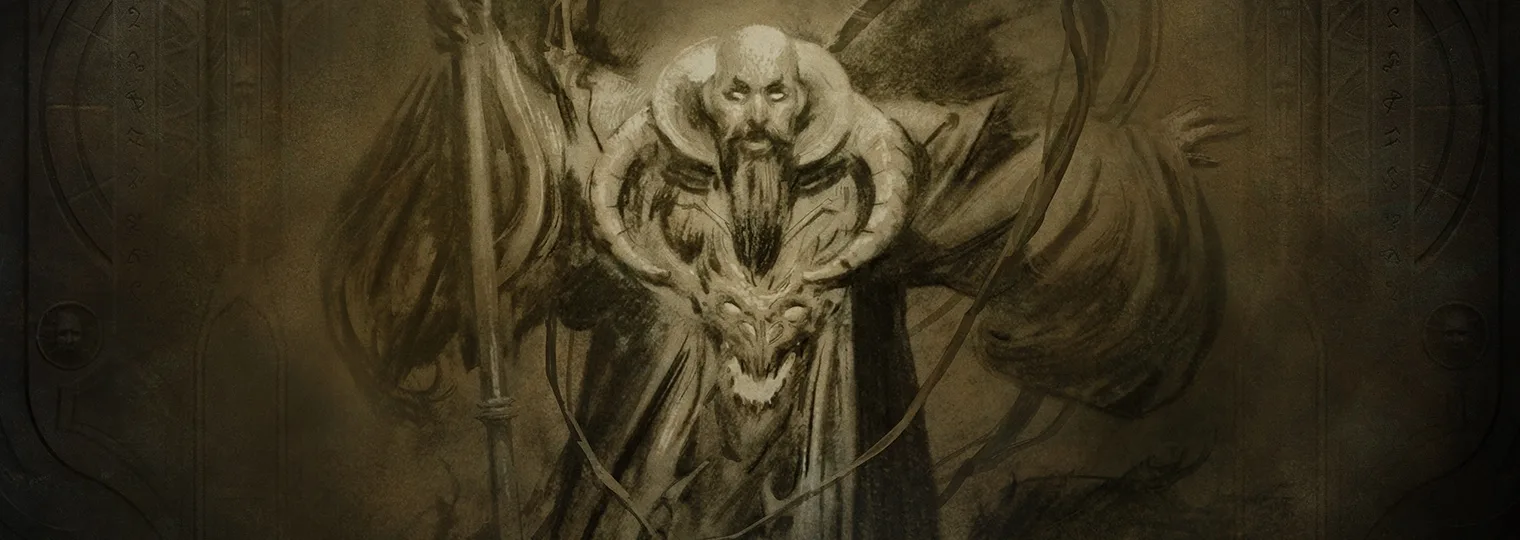
The story centers on the Horadrim Zoltun Kulle. No one understands the power of the nephalem artifact better than he does: Kulle learned to siphon and archive the energies of powerful items into the Cube. That act of "archiving" is exactly what gives the season its name – and its core mechanic.

The narrative image fit the mechanic perfectly: when Kulle opens the forbidden archives, the boundaries between weapon, armor and jewelry magic dissolve. What the normal game keeps strictly separated could, for one season, be freely mixed. A simple lore nod thus became a concrete, tangible rule-break in actual play.
Three freely chosen Cube powers
The heart of the season: for the entire duration of Season 20, the three slots in Kanai's Cube that normally each hold one Legendary power from Weapon, Armor and Jewelry were no longer restricted to their categories. Players could equip any three Legendary powers at once – three weapon effects, or a wild mix across every category.
To grasp why this was so enormous, you need to know how the Cube normally works. Kanai's Cube has three extraction slots, each permanently assigned:
- Weapon slot – holds only Legendary powers from weapons (such as the Furnace's huge elite multiplier)
- Armor slot – only powers from armor pieces like helms, chest armor or shoulders
- Jewelry slot – only powers from rings and amulets
This separation forces every build into hard choices: only one extra power per category is ever allowed. Season 20 tore that wall down.
For the first time in Diablo 3 history, you could combine three effects from the same drawer – three rings, or three weapon passives, all at once.
It sounds simple, but it was one of the most far-reaching changes in Diablo 3 history. Suddenly, builds could stack defensive and offensive powers that normally exclude one another.
- More damage: classes combined several damage multipliers from the same category
- More survivability: defensive legendaries could be cubed alongside offense
- More comfort: quality-of-life effects (resource, mobility) became possible without sacrificing power
Why it was so powerful mechanically
Diablo 3 distinguishes between additive and multiplicative bonuses. Additive bonuses (skill damage, elemental damage) lose value as their total grows. Multiplicative multipliers, by contrast – often tied to Legendaries – multiply with one another and produce exponential damage jumps.
That was the lever: many of the strongest multipliers sat within the same equipment category. Normally you had to choose between them. Season 20 let you cube two or three of those multipliers at once. As a result, the damage of certain builds did not grow linearly but in sharp leaps, with several multiplicative sources layered on top of each other.
At the same time, players could relieve their equipment slots: when an important power lived in the Cube, the matching slot on the character opened up for another Legendary that otherwise could not be worn. This produced stat lines and affix combinations that were simply impossible before.
Impact on the meta
The theme sparked one of the most creative build phases ever. Nearly every class benefited noticeably, and countless builds hit new Greater Rift records because previously impossible combinations could finally be realized. Theorycrafters tested dozens of variants almost overnight, and leaderboards shifted upward across many classes.
Classes with several competing power sources in a single category practically exploded. Builds that had previously been held back by the Cube restriction jumped into the top tier overnight. The pushing community got a real boost, because theoretical damage ceilings suddenly became practically reachable.
Precisely because the theme was universal and disadvantaged no class, many veterans still rank Season 20 among the most fun seasons – one reason Blizzard later brought the theme back as a regular season.
Rewards and the Season Journey
Beyond the Cube theme, Season 20 delivered the usual seasonal incentives:
- Haedrig's Gifts: completing Chapters 2, 3 and 4 of the Season Journey rewarded three gifts that together formed a full Class Set (one set unlockable per season)
- Cosmetic rewards: exclusive badges, a portrait frame, plus pet and cosmetic rewards across the Journey tracks
- Conquests & stash tab: pushing the Journey far enough unlocked an additional stash tab
The Season Journey remained the tried-and-tested onboarding tool, guiding newcomers step by step through the endgame – from a first completed set through Greater Rifts to demanding Conquests. Combined with the Cube theme, getting into pushing was easier than ever, because the freely chosen powers meaningfully strengthened weak early setups.
Patch notes at a glance
Alongside the season theme, Patch 2.6.8 brought:
- Three new class sets (Horde of the Ninety Savages, Mundunugu's Regalia, The Typhon's Veil) plus various balance tweaks to sets and legendaries
- Bug fixes and stability improvements
- Season infrastructure prep (leaderboards, Season Journey)
Worth knowing: the Cube theme was bound exclusively to Seasonal play. In Non-Season, the normal category rules still applied. Anyone who wanted the full force of the three free slots had to roll a seasonal character.
Legacy and significance
In the end, Season 20 was a prime example of how a single, well-chosen theme can reinvigorate the entire build feel of a game – no new items required, just the removal of one old rule. It showed clearly that Diablo 3's depth was far from exhausted, as long as existing systems were creatively rewired.
For the game's long-term development, that was an important signal: mechanical season themes that intervene in existing systems became the preferred way to keep late-life Diablo 3 alive. Season 20 set a benchmark that later themes had to measure up against – and one many players fondly remembered for a long time.
 Login with Battle.net