The 2016/2017 turn of the year was unusually dense for Diablo 3: two seasons followed one another back to back. Season 8 launched on October 21, 2016 and ran through December 30, 2016, with Season 9 beginning right away on January 6, 2017. The minimal gap all but erased the usual multi-week off-season downtime and gave anyone pushing the leaderboards a seamless transition from one fresh start to the next.
For the community it meant a marathon instead of a sprint: players still chasing Paragon and Augments in Season 8 barely had time to lose momentum before the next clean reset was already at the door. That very cadence made the winter of 2016/2017 one of the most intense stretches of the game's mature phase.
The rhythm of seasons
With Season 8, Blizzard firmly settled into a cadence of shorter, predictable season cycles rather than the irregular spacing of earlier years. Each season opened with a clean economic reset: every Seasonal hero began with no gold, no materials and no loot. Players who did not want to level a brand-new character could use Season Rebirth to bring an existing hero into the season, rolling its gear and progress back into the non-seasonal stash.
- A fresh Season Journey with tiered chapters running from beginner through Slayer all the way to Conqueror and Guardian.
- Completing chapters unlocked free Haedrig's Gifts – a full class set, piece by piece, spread across three gift bags.
- Exclusive cosmetic rewards: a seasonal transmogrification set, a portrait frame and a pet, all earnable only during that specific season.
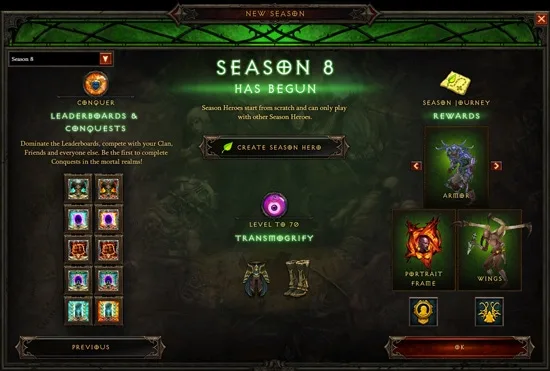
The Season Journey was more than a checklist: it walked newcomers through the most important endgame systems – Kanai's Cube, legendary gems, Greater Rifts and Augments – while giving veterans clear push targets. The staggered Haedrig's Gifts dramatically lowered the barrier to entry: by Chapter IV you already held a complete class set and could jump straight into a functioning build instead of grinding for days hoping for set drops.
Season 8 – the season without a patch
One peculiarity of Season 8 only became apparent on a second look: it launched with no accompanying patch. It was the first season ever to arrive without a fresh batch of new legendaries, balance changes or game features. The seasonal conquests rotated as usual, but the core of the build landscape stayed untouched.
For ambitious players this had a clear effect: the Season 7 meta stayed stable, and established builds like Wrath of the Wastes (Barbarian), Unhallowed Essence (Demon Hunter) and the strong Wizard and Monk builds held onto their top spots. Instead of exploring new sets, the game became about optimizing known setups down to the last detail – maximum Augment values, perfect legendary gems and squeezing every drop out of Kanai's Cube.
Season 9 and Patch 2.4.3
Season 9, by contrast, launched hand in hand with Patch 2.4.3, which brought noticeably more movement into the game. The patch delivered not only the big anniversary event but also concrete build and quality-of-life adjustments:
- The Barbarian's Wrath of the Wastes set got a boost: Whirlwind now additionally triggered the effect of the Dust Devils rune, meaningfully upgrading the spin-to-win playstyle.
- A range of further set and legendary tweaks shifted the fine balance of the leaderboards.
- Dyes moved into their own tab at the Mystic and were no longer sold by vendors.
- Several bug fixes cleared away nagging issues, such as faulty buff behavior when changing floors in Greater Rifts.
That reshaped the meta noticeably: buffed builds pushed into new rift tiers in Greater Rifts, and players once again experimented heavily with set combinations, legendary gems and Cube slots to squeeze the ceiling higher.
Diablo's 20th anniversary
The real star of Season 9, however, was the 20th anniversary of the Diablo series. Announced at BlizzCon 2016, it celebrated two decades since the release of the original Diablo (late 1996). At its heart sat the event The Darkening of Tristram.
The Darkening of Tristram
The event faithfully recreated the dungeon of the original Diablo – complete with a pixelated render filter that visually dragged the modern 3D game back into the 90s. Players descended through 16 floors, met classic bosses and fought their way down to Diablo himself.
- The entrance was a portal in the Old Ruins of Tristram, right next to the fountain.
- Floor by floor, the event reconstructed iconic enemies and the grim atmosphere of the original.
- On the lowest floor waited the final showdown with the Lord of Terror.
- After victory, players could unlock achievements, an anniversary pet and a portrait frame.
The Tristram anniversary tied seasonal progress to a loving homage to the series' own roots for the first time.
The Red Soul Shard
The most coveted reward was the Red Soul Shard – a unique legendary gem and the only one of its kind that could be socketed into the helm slot, evoking Diablo's own soulstone. It dropped from the Dark Lord (Diablo) at the end of the dungeon.
- The shard periodically unleashed a ring of fire that damaged enemies.
- At higher ranks it gained a second effect: after a character or Paragon level-up, the resource costs and cooldowns of all skills were briefly slashed.
- It could transmogrify the helm visually and stayed permanently in the inventory – earned once, kept forever.
A tradition is born
What began as a one-time anniversary celebration became a fixed institution. The Darkening of Tristram went on to return every January – a reliable destination for anyone who did not yet own the Red Soul Shard or simply enjoyed the nostalgia.
In doing so, Blizzard established a pattern that shaped Diablo 3's lifespan: recurring, season-bound events that provided variety between fresh restarts. The Tristram event became the template for later limited-time content and showed how nostalgia and ongoing progression could be married together.
Why it mattered
The tight succession of Seasons 8 and 9 marked a turning point: Diablo 3 had perfected its seasonal loop. Regular, predictable starts gave the community a reliable beat, and the contrast between a quiet, patchless Season 8 and a content-rich Season 9 showed in exemplary fashion how Blizzard balanced stability against novelty.
For many players, this turn of the year came to embody what Diablo 3 was all about in its mature phase – snappy resets, clear goals and a knowing wink at its own roots. The seasonal structure that received its final polish here would form the framework for all the years that followed, in which Diablo 3 stayed alive through regular seasons and anniversary events.
 Login with Battle.net