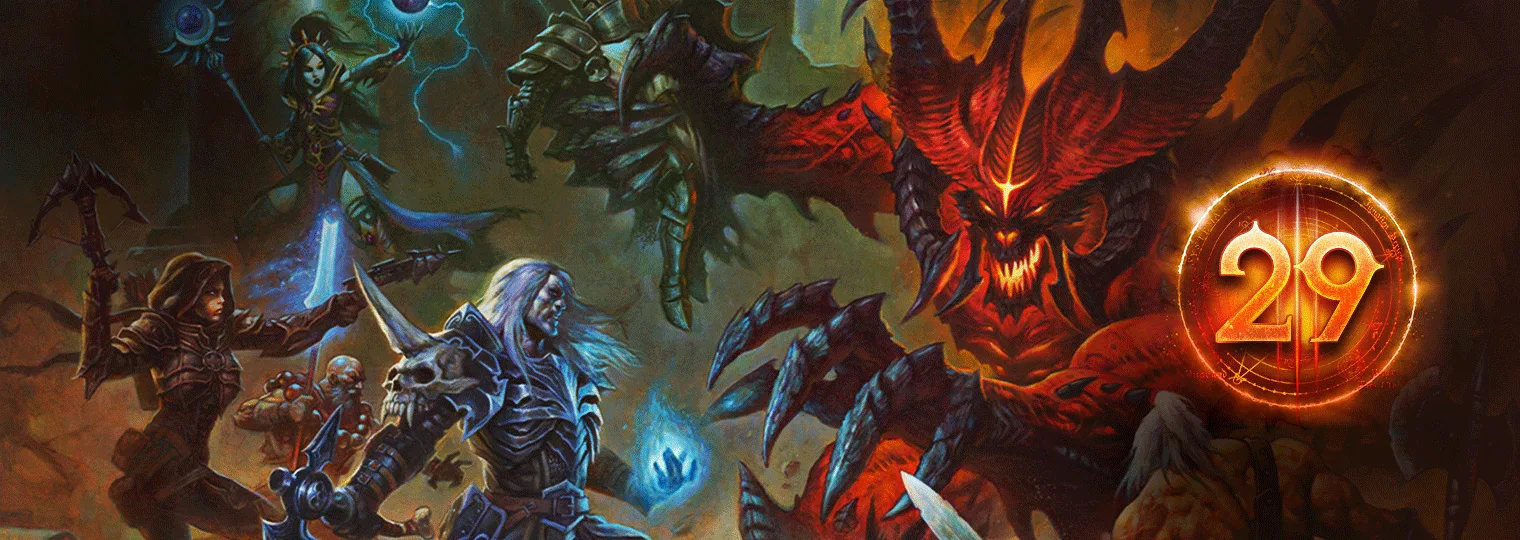
Season 29 'Visions of Enmity' launched on September 15, 2023 at 5 p.m. CEST, bringing a theme that looked almost too simple at first glance – and precisely because of that turned out to be one of the most addictive in all of Diablo 3's history: red portals. As you cut down demons across the open world of Sanctuary, a Diabolical Fissure can open at any moment — a swirling, hellishly red-glowing portal that pulls you into an unstable hellish enclave. Unlike many earlier themes that forced a separate activity or a bespoke item system, this concept deliberately hooked into the normal loot loop in a low-friction, seamless way.
The concept behind Season 29
By 2023, Diablo 3 had long been in official maintenance mode: no more major expansions, no new classes, just seasonal themes meant to re-season the endgame loop every three to four months. Within that framework, Visions of Enmity was a textbook example of strong game design under constraints. Instead of complex new mechanics, Blizzard leaned on a single, instantly understandable hook: the unpredictable tearing-open of a portal mid-farm. The theme required no explanation, no tutorial step, and no extra resource — it simply rewarded what players were already doing nonstop, namely killing monsters.
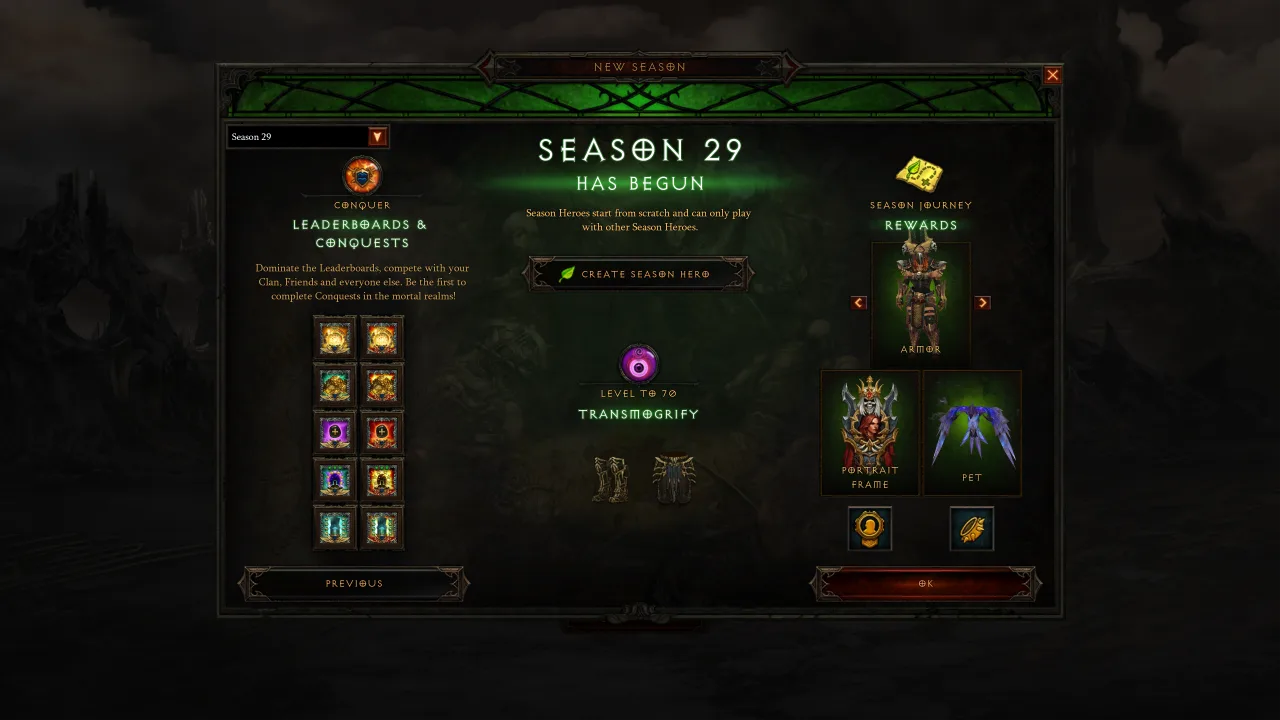
The genius of Season 29 wasn't in its complexity but in its frictionlessness: it added a gambling thrill to the existing loop without ever interrupting it.
Diabolical Fissures
Starting as early as character level 1, Nephalem have a chance to trigger a Diabolical Fissure by slaying demons out in the open world. There's no key, no recipe, and no setup — you simply farm as usual, and suddenly the ground tears open. That randomness is exactly what made the theme so compelling: every demon you killed could be the one that opens the next portal. The mechanic deliberately echoed the unplanned tension of early Diablo systems, where the next big drop event was never announced, only experienced.
Crucially, the trigger chance is tied to demon kills — not to raw speed or difficulty alone. Players who pulled dense demon packs in the campaign or Adventure Mode and dropped them in one blow effectively raised their Fissure frequency. This created a natural incentive to play aggressively and on the move right from the leveling phase.
Visions of Enmity
Step through a Fissure and you enter a Vision of Enmity — a compact hellish instance packed with enemies and loot. What awaits inside is never quite predictable, but the reward density is consistently high. The rooms are kept small, so barely any movement is wasted — a deliberate contrast to the sometimes sprawling Nephalem Rift maps.
Crucially, the Visions are unstable and can spawn additional Fissures after you dispatch enemies inside. Play aggressively and you create entire chains of portals, pulling you ever deeper into the loot spiral. Once you found the rhythm, you hopped from Vision to Vision without ever needing to return to town.
- Visions from level 1 — the theme carries you through the entire leveling experience
- Chained Fissures for near-seamless farming without returning to town
- High loot density to assemble sets and Ancients quickly
- Compact instances with minimal travel for maximum throughput
Exclusive monster affixes
New powers originating from the Burning Hells were bestowed upon every enemy inside the Visions, making them far more lethal than their counterparts outside. These affixes are available only in Visions of Enmity. They ensured that, despite their size, the rooms never degenerated into pure loot dispensers but demanded real situational awareness.
The most infamous was Enervating: an area of effect around the monster that reduces the player's Movement Speed by 65% and Cooldown Reduction by 50% while in the vicinity. Walk carelessly into a pack and you could suddenly find yourself crippled and surrounded — especially for builds that rely on high mobility or short cooldowns, this was a genuine shock.
Why the affixes deepened the theme
The exclusive powers gave an otherwise highly accessible theme a tactical layer. Players learned to read rooms, to detonate dangerous affix combinations from a distance or avoid them outright, and to adjust their build priorities. As a result, even the hundredth portal still carried a small risk — rather than decaying into dull routine.
Paragon Ceiling and solo mode
Season 29 delivered more than just portals. With the accompanying patch, Blizzard introduced the first-ever Paragon Ceiling — a cap that reined in the endless Paragon arms race on the leaderboards and put builds, rather than sheer hours grinded, back in the spotlight. For years the ranking race had primarily rewarded whoever poured the most time into Paragon grinding; the ceiling shifted focus back to gear, playstyle, and clever optimization.
It also added a solo play mode for self-found fans who wanted to compete without group boosting. This gave solo players a fairer benchmark, decoupled from coordinated four-player groups. Both changes were long-term structural decisions that outlasted the season theme itself and meaningfully reshaped the game's competitive landscape.
Place within the 'Remixed Seasons'
Visions of Enmity was the last brand-new season theme before Blizzard began re-running proven themes roughly every three months from Season 30 on – joined by the Altar of Rites and the Visions themselves, which have been part of every Season since. The red-portals concept fit this philosophy seamlessly because it paired minimal development effort with maximum play appeal.
Legacy and return
The red-portals concept has since become one of the most beloved season themes of all — simple enough to grasp instantly, and addictive enough to keep players engaged for weeks. The community quickly held it up as the benchmark for how a good remix theme should work: no artificial hurdle, no mandatory mechanic, just a bonus that amplifies the core gameplay. The fact that Blizzard made the Visions a fixture of every Season from Season 30 on underscores how squarely Visions of Enmity hit the player base's nerve. For many, Season 29 remains the prime example that a season theme doesn't have to be complicated to be great — it just has to deliver the right thrill at the right moment.
 Login with Battle.net